We had been using a ball mill to mill ceramics, but because ceramics are extremely hard materials, it was difficult to reach the target particle size.
With the Vibrating Mill, even hard raw materials can be finely milled thanks to its overwhelming impact forces.
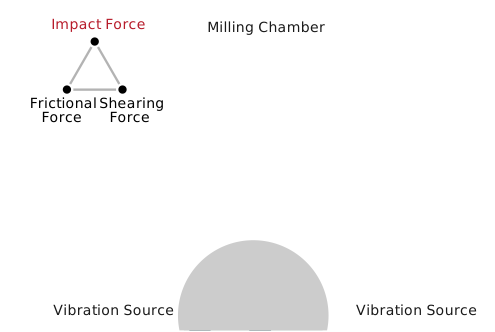
In the Vibrating Mill, the milling chamber is subjected to high-speed circular vibration (1,000–1,200 cycles per minute), generating strong impact forces (collisions) from the media to the material, enabling fine
milling even of hard raw materials.
The Vibrating Mill is also used to mill the following materials:
diamond, metals, alumina, silicon nitride, and silicon carbide, etc.
Fine milling was achieved, and we were able to reach the target particle size.
02
Textile manufacturer
Unable to finely mill fibers.
We had been using a ball mill to mill glass wool, but fibers tended to remain, making it difficult to cut them into short pieces for fine milling.
With the Vibrating Mill, fibers can also be milled efficiently.
In the Vibrating Mill, continuous impact and shear generated by vibration are applied to the feed material, enabling efficient milling of fibrous materials.
The Vibrating Mill is also used to mill the following fibrous materials:
ceramic fibers and rock wool, etc.
The fibers were finely milled.
03
Electronic materials manufacturer
The raw material agglomerates.
We had been using a ball mill to mill deliquescent materials, but the material often absorbed moisture during milling and discharge, causing agglomeration.
With the Vibrating Mill, agglomeration can be suppressed.
The Vibrating Mill allows milling under an inert-gas atmosphere to reduce moisture uptake and prevent agglomeration.
During discharge as well, moisture uptake can be prevented by maintaining a closed system: connect the milling chamber and the material discharge hopper with a flexible tube and discharge the material while keeping the
inert-gas atmosphere.
Agglomeration was reduced.
04
Beverage manufacturer
Milling takes too long.
For green tea beverage production, we needed to mill large volumes of tea leaves and had been using a stone mill, but the milling process took a long time.
With The Vibrating Mill, milling is faster.
In the Vibrating Mill, the milling chamber is subjected to high-speed circular vibration (1,000–1,200 cycles per minute), generating strong impact force and a high frequency of impacts (collisions) from the media to
the material, enabling large-volume milling in a short time.
By installing a cooling jacket on the outside of the milling chamber, temperature rise due to milling heat can be suppressed.
Milling time was reduced.
05
Electronic component manufacturer
Severe wear requires significant labor for liner replacement.
We had been using a ball mill to grind coil material, but because of its high hardness, liner wear was severe and a large amount of labor was spent on liner replacement.
With The Vibrating Mill, liner replacement is easier and can be completed in less time.
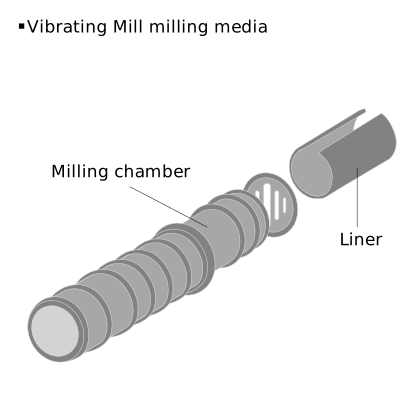
Unlike a ball mill, where the milling chamber must be removed to replace the liner, The Vibrating Mill allows the liner alone to be removed without removing the milling chamber, so liner replacement can be completed
quickly. As a result, equipment downtime can be reduced and production can be restored sooner.
The Vibrating Mill is also used to mill the following hard materials:
diamond; ceramics (alumina, zirconia, silicon nitride, silicon carbide, etc.); neodymium magnets; abrasives; iron powder; tungsten carbide; chromium; ferromanganese; ferrites; calcium carbonate; inorganic pigments; and
granulated blast-furnace slag, etc.
The liners can be removed without disassembling the milling chamber.
The labor required for liner replacement was reduced, improving work efficiency.
06
Magnetic materials manufacturer
Want to reduce wear on the milling chamber liner.
We had been grinding neodymium magnets with a ball mill, but their high hardness caused severe wear on the milling chamber liner.
With The Vibrating Mill, wear can be reduced.
Because The Vibrating Mill allows you to select the liner material inside the milling chamber, wear can be reduced by fitting the liner with high-manganese steel plate, which offers high wear resistance.
The Vibrating Mill is also used to mill the following hard materials:
diamond; ceramics (alumina, zirconia, silicon nitride, silicon carbide, etc.); neodymium magnets; abrasives; iron powder; tungsten carbide; chromium; ferromanganese; ferrites; calcium carbonate; inorganic pigments; and
granulated blast-furnace slag, etc.
We were finally freed from a wear problem that had troubled us for years.
07
Abrasives manufacturer
Want to reduce metallic contamination during milling.
We had been milling abrasive raw materials with a ball mill, but metallic contaminants caused by wear from the mill canister and the media mixed in during milling, and we could not achieve the purity required for the
abrasives.
With The Vibrating Mill, there is no metallic contamination.
Because The Vibrating Mill can use high-purity ceramics with excellent wear resistance, as well as non-metallic materials (natural rubber, polyurethane rubber, nylon, etc.) for the milling media and liners, it prevents
metallic contamination.
Metallic contamination was eliminated, and we achieved the target purity.
08
Ceramics manufacturer
Want to reduce the cost of replacing consumable parts.
With the conventional mill we used, only dedicated parts could be used when replacing consumables, and the cost of obtaining these parts was high.
With the Vibrating Mill, procuring consumables is easy and low cost.
Because the parts used in the Vibrating Mill include commercially available items, parts are easy to procure and maintenance costs can be reduced.
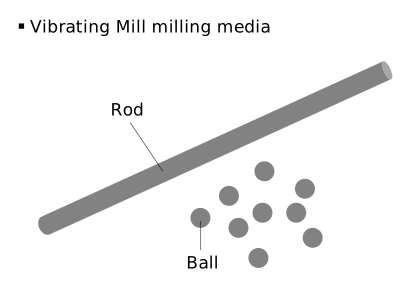
Commercially available balls (steel and ceramic) and rods (round bars) can be used as milling media for our Vibrating Mill.
We were able to significantly reduce the cost of replacing consumables.
09
Electronic component manufacturer
Quality deteriorates due to oxidation of the material during milling.
We had been using a ball mill to grind raw materials for transparent electrodes, but oxidation of the material was severe and quality was declining.
With The Vibrating Mill, oxidation can be prevented during feeding, milling, and discharge under an inert atmosphere.
In The Vibrating Mill, the milling chamber, the material feeding unit, and the discharge hopper can be connected with flexible tubing to create a sealed system, enabling material feeding, milling, and discharge under
an inert gas atmosphere and preventing oxidation.
The Vibrating Mill is also used to mill the following oxidation-prone materials:
neodymium magnets, aluminum powder, iron powder, silver, manganese, rare-earth materials, and matcha, etc.
Quality improved by preventing oxidation.
10
Metal materials manufacturer
Nitrogen gas costs are a burden when milling combustible materials.
We had been using a ball mill to grind fine metal powder, but because the material is combustible, we operated it under a nitrogen atmosphere to avoid contact with air. Nitrogen consumption was high, resulting in
significant cost.
With The Vibrating Mill, nitrogen consumption can be reduced.
With the batch-type Vibrating Mill, the milling chamber, the material feeding unit, and the discharge hopper can be connected with flexible tubing to create a sealed system, enabling feeding and discharge under an
inert gas atmosphere and minimizing nitrogen use to the necessary minimum.
The Vibrating Mill is also used to mill the following combustible materials:
sulfur, aluminum, and magnesium, etc.
We were able to reduce nitrogen gas costs.
11
Conductive materials manufacturer
Want to make the raw material flake-shaped.
We needed to micronize the conductive material and turn it into flake-shaped powder.
With The Vibrating Mill, the material can be processed into flake-shaped particles.
The Vibrating Mill allows various milling media to be selected depending on the material and the objective, and the impact of small-diameter balls can flatten the particles into flakes.
The desired flake-shaped powder was obtained.
12
Construction materials manufacturer
Want to remove the surface layer of silica sand.
To recycle used silica sand, we want to grind off surface contaminants.
With The Vibrating Mill, you can grind off only the surface without excessively breaking the particles.
With The Vibrating Mill, the grinding force can be adjusted by selecting the vibration amplitude, motor speed, grinding time, and the material and size of the grinding balls, allowing you to grind off only the surface
without excessively damaging the particles.
The dirt was removed from the silica sand, making it recyclable.
13
Ceramics manufacturer
Want to increase the bulk density of the raw material.
Because the ceramic fiber was light and bulky, the amount that could be filled into FIBC (flexible intermediate bulk container) bags for truck loading during transport was limited, which increased logistics costs.
With The Vibrating Mill, milling is possible while increasing bulk density.
With The Vibrating Mill, the impact force generated by vibration enables milling while compressing the fibers, reducing voids between fibers and increasing bulk density.
The Vibrating Mill is also used to mill fibrous materials such as glass wool.
Bulk density increased, allowing a higher payload and reducing logistics costs.
14
Ferrite manufacturer
Dust scattering is severe during feeding and discharging of the milled material.
Previously, we used a ball mill for dry milling of ferrite, but dust scattered heavily during material feeding and discharge, worsening the working environment. In addition, the cost of installing a dust collector and
the time required for dust collection were a major burden.
With The Vibrating Mill, dust scattering can be prevented.
With The Vibrating Mill, the milling chamber, the feed unit, and the discharge hopper can be connected with flexible tubing to form a sealed system, enabling enclosed feeding and discharge and preventing dust
dispersion.
Dust collection equipment becomes unnecessary, helping maintain a safe working environment.
With The Vibrating Mill, dust dispersion can also be prevented for the following materials:
carbon black, gypsum, slaked lime, fibrous materials (glass wool, ceramic fiber, etc.), activated carbon, sulfur, granulated slag, unburned debris, etc.
By preventing scattering, the work environment was improved,
and cost reduction and work efficiency improvements were also achieved.
15
Chemical manufacturer
Want to automate the milling process.
We had been using a ball mill for dry milling, but it could not be automated, and labor costs were a burden.
With the Vibrating Mill, automation is possible.
With the Vibrating Mill, automatic operation is possible by connecting the feed unit and the discharge hopper with flexible tubing, which helps reduce labor costs.
Automation reduced labor costs.
16
Conductive material manufacturer
Material discharge was time-consuming.
We were grinding with a rotary ball mill using small-diameter balls, but the discharge slit area was small and the small balls clogged the slits. Even when the mill was shaken by rotation, the material did not
discharge smoothly from the outlet, so discharge took a long time.
With the Vibrating Mill, material discharge is faster.
In the Vibrating Mill equipped with a inverting-discharge system, the discharge slit area is large, and vibration helps the material pass through the slits more easily, enabling discharge in a short time. (The grinding
balls are retained by the slits and are not discharged outside the milling chamber.)
The material discharge time was reduced.
17
Food manufacturer
Want to contain odors during discharge.
We had been using a ball mill to grind garlic, but odors spread into the surrounding area during discharge, worsening the work environment.
With the Vibrating Mill, material can be discharged in a sealed system.
With the Vibrating Mill, the milling chamber and the discharge hopper can be connected with flexible tubing to create a closed system, allowing the material to be discharged while containing odors.
Odors were contained during discharge, improving the work environment.
18
Usage proposals from CHUO KAKOHKI
With the Vibrating Mill, not only milling but also mixing is possible.
By using the Vibrating Mill without media (balls) and charging only the raw materials, the raw materials can be mixed.
In addition, mixing in a sealed condition is possible.
Problem-Solving Case Studies for Vibrating Dryers
01
Electronics materials manufacturer
Wants to shorten the cleaning time of the dryer.
We had been using an agitated dryer and a conical dryer, but because we dried many small-lot products, cleaning during product changeover was time-consuming.
With the Vibrating Dryer, cleaning can be done in a short time.
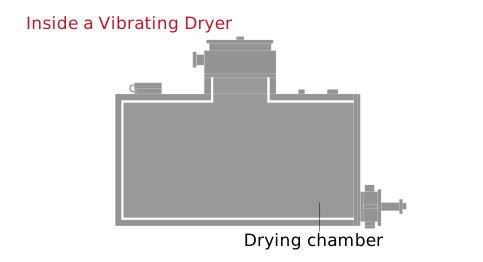
Because the Vibrating Dryer has a simple structure with no agitator blades inside the drying chamber, it is easy to clean and can be washed in a short time.
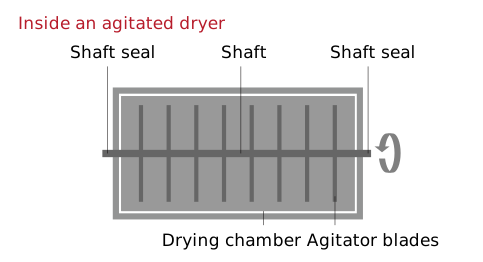
Because it has a complex structure with agitator blades and shaft seals inside the drying chamber, cleaning takes a long time.Because it has a simple structure with no agitator blades inside the drying chamber, it is easy to clean.
By shortening the cleaning time,
production efficiency has increased and operator fatigue has been reduced.
02
Food manufacturer
Want to reduce maintenance costs.
We had been using an agitated dryer, a conical dryer, and a filter dryer, but inspections and parts replacement for the drying equipment were costly and time-consuming.
With the Vibrating Dryer and Vibrating Filter Dryer, maintenance is easy and low-cost.
The Vibrating Dryer and Vibrating Filter Dryer have no agitator blades inside the drying chamber, so inspection and replacement of shaft seals are unnecessary. In addition, because there is no agitator shaft, no
maintenance is required for problems caused by raw material biting into sliding parts or contamination from abrasion powder.
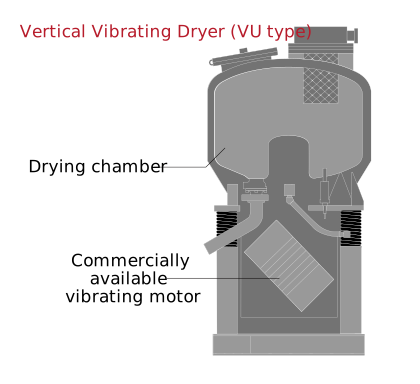
Furthermore, with the Vertical Vibrating Dryer (VU type), a commercially available vibrating motor is used in the drive section, so even if trouble occurs, parts can be procured easily and at low cost.
Because there are no agitator blades, inspection and replacement of shaft seals are unnecessary.
We achieved cost reductions in inspections and parts replacement,
and were also able to reduce labor costs for maintenance.
03
Resin manufacturer
Want to perform drying with corrosion resistance using special steel materials.
We want to use a dryer made of special steel for corrosion resistance, but it becomes very expensive.
With the Vibrating Dryer, even if special steel is used, costs remain low.
In the Vibrating Dryer, there are no agitator blades inside, so corrosion resistance can be achieved simply by adding a thin lining (plate) to the main body, which keeps costs down (only a small amount of special steel
is required).
Corrosion resistance was achieved, and it also led to cost reduction.
04
Electronics materials manufacturer
We are looking for a dryer that can be corrosion‑resistant treated for drying acidic raw materials.
We need to dry acidic raw materials and are searching for a dryer that can be corrosion‑resistant treated, while keeping the cost of the corrosion‑resistant treatment as low as possible.
With the Vibrating Dryer, corrosion‑resistant treatment is possible at low cost.
Because the Vibrating Dryer has no agitator blades inside, corrosion‑resistant treatment by Teflon coating is easy, which helps reduce costs.
Corrosion resistance was achieved, and it also led to cost reduction.
05
Chemical manufacturer
Cannot choose Teflon coating, so corrosion-resistant treatment is not possible.
We were considering applying Teflon coating to an agitated dryer, but when we consulted the manufacturer, we were told it would wear easily and could not be selected.We had no idea of any alternative method.
With the Vibrating Dryer, Teflon coating can be selected.
Since the Vibrating Dryer has no internal agitator blades, wear on the Teflon coating is minimal.
Therefore, Teflon coating can be selected, making corrosion-resistant treatment possible.
Teflon coating became an option, and corrosion resistance was achieved.
06
Chemical manufacturer
Want to reduce the maintenance cost of Teflon coating.
We had applied Teflon coating to a double-cone dryer, but the high cost of repairs and replacement had become a problem.
With the Vibrating Dryer, repairs and re-coating of the Teflon coating can be done at low cost.
Because the Vibrating Dryer has a simple structure with no agitator blades inside the drying chamber, it is easy to repair or re-apply the Teflon coating, which helps reduce maintenance costs.
We were able to reduce the maintenance costs that had been a burden for many years.
07
Electronic materials manufacturer
The agitator blades of the agitated dryer wear out frequently.
We had been using an agitated dryer, but because we were drying highly abrasive materials, the agitator blades were wearing out frequently.
The Vibrating Dryer has no agitator blades.
Since the Vibrating Dryer has no agitator blades inside the drying chamber, there is no risk of blade wear.
In addition, compared with conventional dryers that have agitator blades, wear on the vessel itself is reduced.
We have been freed from the wear issues that had troubled us for many years.
08
Recycled materials manufacturer
We didn’t have enough budget to purchase a dryer.
We wanted to purchase a dryer, but our internal budget was limited, so it was difficult to introduce one.
CHUO KAKOHKI also manufactures dryers that are eligible for subsidies.
At CHUO KAKOHKI, we also manufacture dryers that qualify for subsidies, and after confirming the customer’s needs, we propose machines that can be covered by such subsidies.
A subsidy was granted, making the introduction of the dryer possible.
09
Recycled materials manufacturer
We are looking for a small-scale unit
in order to conduct small-batch research in-house.
The Vibrating Dryer is available in laboratory models.
The Vibrating Dryer is available in laboratory-scale models starting from a minimum capacity of 50 cc.
Small-batch research became possible in-house.
10
Food manufacturer
The air consumption of the fluidized bed dryer is a burden.
We had been using a fluidized bed dryer, but the large volume of air required had become a cost burden.
With the Vacuum Vibrating Fluid Bed Dryer, air consumption is low and costs are reduced.
Unlike conventional horizontal fluidized bed dryers, CHUO KAKOHKI’s vertical Vacuum Vibrating Fluid Bed Dryer can form a stable fluidized bed with a small amount of air, resulting in lower air consumption and reduced
costs.
When using expensive gases such as nitrogen for drying, the cost difference is significant.
Air consumption was reduced, achieving a substantial cost reduction.
11
Electronics materials manufacturer
The cost of nitrogen used in the fluidized bed dryer is a burden.
To dry materials that are sensitive to humidity, we had been using nitrogen in a fluidized bed dryer, but the large amount of nitrogen required had become a cost burden.
With the Vacuum Vibrating Fluid Bed Dryer, nitrogen consumption is low and costs are reduced.
Because the Vacuum Vibrating Fluid Bed Dryer can form a stable fluidized bed with a small amount of nitrogen, it reduces nitrogen consumption and cuts costs even when drying humidity-sensitive materials, deliquescent
materials, and materials that require protection against oxidation.
Nitrogen consumption was reduced, leading to cost savings.
12
Functional food manufacturer
Want to shorten the drying time.
With the vacuum dryer we had been using, the drying time was long.
With the Vacuum Vibrating Fluid Bed Dryer, drying time can be shortened.
Because the Vacuum Vibrating Fluid Bed Dryer fluidizes the material with a small amount of gas by means of vibration, it can dry efficiently and shorten the drying time.
The drying time was reduced, and production efficiency increased.
13
Usage proposals from CHUO KAKOHKI
The Vacuum Vibrating Fluid Bed Dryer can be used not only for drying but also for humidity control.
Because the Vacuum Vibrating Fluid Bed Dryer provides uniform fluidization by vibration and precise humidity control, it can condition the moisture content of the entire powder evenly and efficiently.

 Problem-Solving Case Studies

 01
01