
When you hear the term “vibrating mill,” can you picture what kind of machine it is?
In this article, we explain how a vibrating mill works and how it grinds materials, with a focus on readers who are new to this type of equipment.
How Does a Vibrating Mill Work?
A vibrating mill is a type of ball mill in the broad sense.
A conventional rotary ball mill rotates a drum (grinding cylinder) containing grinding media. In contrast, a vibrating mill vibrates the grinding cylinder itself, causing the media inside to move. This is the key difference between the two types of mills.
In a vibrating mill, unbalanced weights are mounted on the shaft of the vibration mechanism. As the weights rotate, they generate centrifugal force, causing the grinding cylinder to undergo high-speed circular vibration at 1,000–1,200 cycles per minute.
This vibrational energy is transmitted to the grinding media (balls or rods) inside the cylinder. Intense impacts and friction between the media and the inner wall of the cylinder, as well as between the media themselves, grind the material into fine particles in a short time.
While a conventional rotary ball mill operates at an acceleration of approximately 1 G, a vibrating mill can achieve 6–10 G. Its grinding capacity can reach 10–20 times that of a conventional rotary ball mill.
Inside a Vibrating Mill: Structure and Operation
Inside the grinding cylinder of a batch-type vibrating mill (FV model)
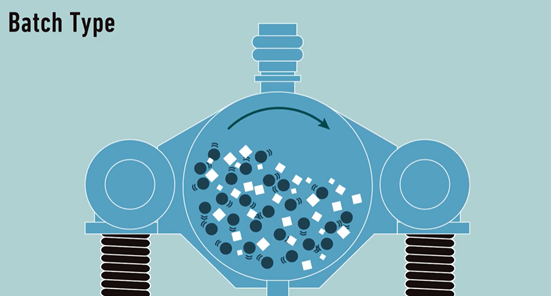
The material is ground in a short time through intense collisions between the grinding media and the material.
The grinding media can be selected from balls or rods, depending on the application.
You can see how our vibrating mills operate in product introduction videos on CHUO KAKOHKI’s official YouTube channel:
・Continuous Vibrating Mill (CD Type)
・Batch Vibrating Mill (FV Type)
・Batch Inverting Vibrating Mill (MB Type)
CHUO KAKOHKI’s Vibrating Mills
In 1961, CHUO KAKOHKI introduced Japan’s first high-efficiency fine grinding machine of this type: the vibrating mill.
Since then, we have continuously improved our technology based on decades of experience and practical application, developing a range of models to meet diverse customer needs.
Our vibrating mills are used in a wide range of industries, including ceramics, metals, food, pharmaceuticals, and advanced materials. Their applications extend beyond fine grinding to include intermediate grinding, dispersion, precision mixing, deagglomeration, and mechanochemical processing.
We also offer grinding components made from a variety of materials to suit the properties of the materials being processed and the intended application.
Inquiries and Sample Testing
Please feel free to contact us for advice on selecting a vibrating mill, evaluating grinding conditions, or arranging sample tests using your materials.
[Contact Us / Request a Sample Test]