
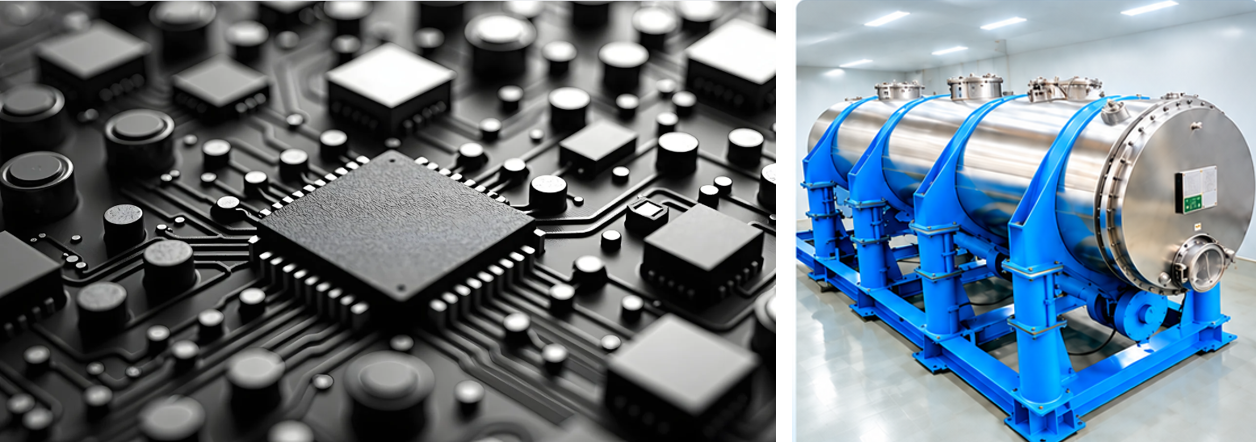
Vibrating Drying Technology Supporting Semiconductor Material Manufacturing
Semiconductor materials must meet extremely stringent quality requirements, including high levels of dryness and the prevention of foreign matter contamination.
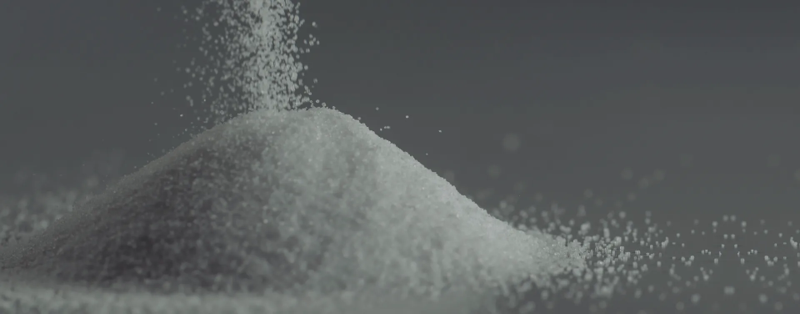
CHUO KAKOHKI's Vibrating Dryer can reduce residual moisture content to 100 ppm or less after drying.
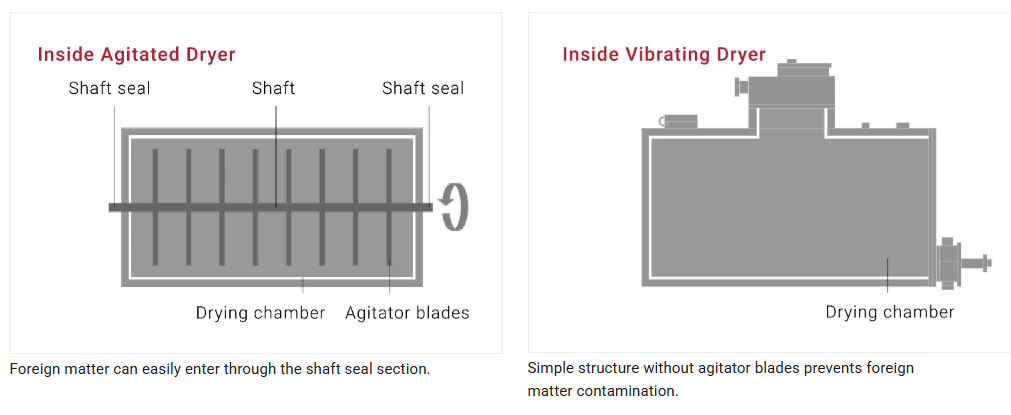
Furthermore, its design without agitator blades prevents foreign matter contamination through agitator blade shaft seals, helping maintain the stringent quality standards required for semiconductor materials.
Drawing on over 70 years of accumulated experience and expertise, we design our equipment in compliance with relevant standards, including ASME standards, to support stable operation over a service life of 20 years or more.
Technology Supporting the Quality Requirements of Semiconductor Materials
Table of Contents
- 1 Technology Supporting the Quality Requirements of Semiconductor Materials
- 2 Design and Manufacturing for High Quality and Reliability
- 3 Main Applications in Semiconductor and Advanced Materials Manufacturing
- 4 Laboratory Testing
- 5 Related Technologies: Next-Generation Drying Technology Incorporating Microwave Technology
High Dryness Levels
Our Vibrating Dryer can reduce residual moisture content to 100 ppm or less after drying, achieving the stringent dryness requirements of semiconductor materials.
Furthermore, it utilizes vacuum drying technology to significantly shorten drying time.
We have achieved approximately 50% shorter drying times compared to conical dryers.
Prevention of Foreign Matter Contamination
Our Vibrating Dryer agitates powder solely through vibration of the drying chamber, without the use of mechanical stirring.
Since there are no agitator blades inside the drying chamber, there is no risk of foreign matter contamination from agitator blade shaft seals. This helps meet the stringent quality requirements of semiconductor materials.
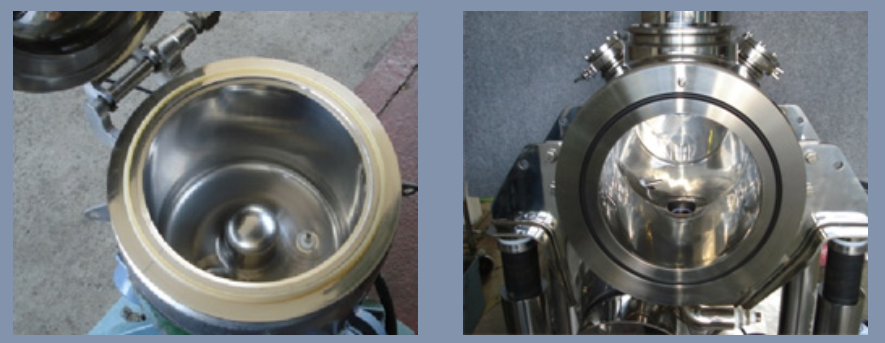
VU Type – Interior View VH Type – Interior View
Design and Manufacturing for High Quality and Reliability
Design in Compliance with Applicable Standards
We pursue high quality and safety through design and manufacturing in compliance with relevant standards, including ASME standards.
Our meticulous attention to every detail in the design ensures excellent durability.
Furthermore, we use highly reliable Japanese-made components for major drive systems, supporting stable operation over a service life of 20 years or more.
Rigorous Manufacturing Quality Control
We maintain strict quality control throughout every manufacturing process, including welding, casting, machining, and precision assembly.
Main Applications in Semiconductor and Advanced Materials Manufacturing
Our Vibrating Dryer supports manufacturing processes for a wide range of materials, including semiconductor materials, battery materials, and other advanced materials.
The main applications include:
1. Vacuum Drying of Silicon and Silicon Carbide (SiC) Materials for Semiconductors
Our Vibrating Dryer is suitable for the vacuum drying of silicon-based powders, crushed polycrystalline silicon, silicon carbide (SiC) powders, and other materials. Its high drying performance and contamination prevention help meet the stringent quality requirements of semiconductor materials.
2. Drying of Ceramic Substrates and Thermal Management Materials for Semiconductors, and Nitriding Treatment
Our Vibrating Dryer is suitable for drying ceramic powders such as aluminum nitride, silicon nitride, and alumina, which are used as raw materials for semiconductor package substrates and heat-dissipating ceramics. It also supports uniform nitriding treatment of metal powders.
3. Drying and Mixing of Polishing Materials for Semiconductor Manufacturing
Our Vibrating Dryer is suitable for drying and mixing polishing powders, such as silica and cerium oxide, used in chemical mechanical planarization (CMP) to achieve a flat surface on semiconductor wafers.
4. Drying of Target Materials for Semiconductor Manufacturing
Our Vibrating Dryer is suitable for vacuum drying and premixing metal powders and alloy powders used in target material manufacturing. It also supports the processing of nickel powders, rare earth powders, and other materials for the semiconductor industry.
5. Drying of Battery Materials and Other Advanced Materials
Our Vibrating Dryer is suitable for drying a wide range of advanced materials, including ternary precursors, sulfide-based solid electrolytes, fluorine-containing electrolyte powders, anode materials, graphite, and carbon-based powders, as well as copper and silver powders for the solar cell industry.
The drying process for powders is an important step that affects the quality of semiconductor materials as well as subsequent manufacturing processes.
CHUO KAKOHKI's Vibrating Dryer helps meet the stringent quality requirements of semiconductor materials through its high drying performance and design that prevents foreign matter contamination. This supports the stable production of semiconductor materials and contributes to the development of the global semiconductor industry.
If you have any challenges or concerns regarding drying equipment or drying processes for semiconductor materials or other advanced materials, please feel free to contact CHUO KAKOHKI.
Laboratory Testing
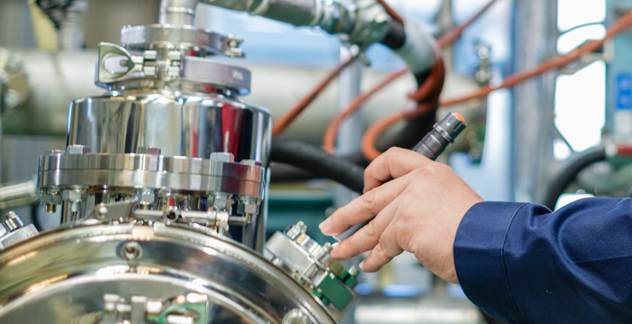
We conduct tests using customers’ own materials on our small‑scale vibrating mills and vibrating dryers.
Based on the test process and results, we study scale‑up to commercial machines and suitable operating methods.
For drying tests, we also have all necessary auxiliary equipment in place to handle a wide variety of trials.
Related Technologies: Next-Generation Drying Technology Incorporating Microwave Technology
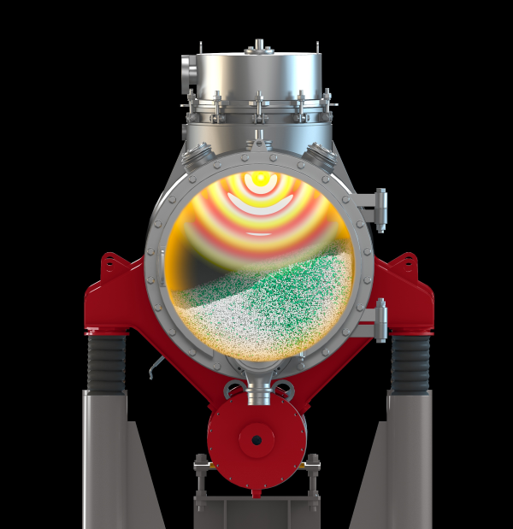
Microwave Vibrating Dryer
CHUO KAKOHKI's Vibrating Dryer is a vacuum dryer that uses a unique drying method. The entire drying chamber undergoes high-speed circular vibration on springs, using vibration energy to agitate the powder and granules while applying indirect heating to dry the material.
Building on this technology, we have developed a new dryer that incorporates microwave heating (direct heating). This development also aims to suppress the inclusion of metal wear particles and achieve even higher-quality powder drying.
By combining direct and indirect heating in a hybrid heating system, the dryer significantly shortens drying time and helps prevent agglomeration.
This next-generation drying system combines microwave and indirect heating to reduce fossil fuel consumption, helping to lower CO₂ emissions and improve productivity.
Applications

Organic Materials:Polymeric materials, functional materials, engineering plastics, elastomers, and more

Inorganic Materials:Advanced ceramics, inorganic electronic component materials, and more